

The narrative is the part of the PCR that nurses, doctors, lawyers, and reviewers read first. Everything else in the report supports it. Write it accordingly.
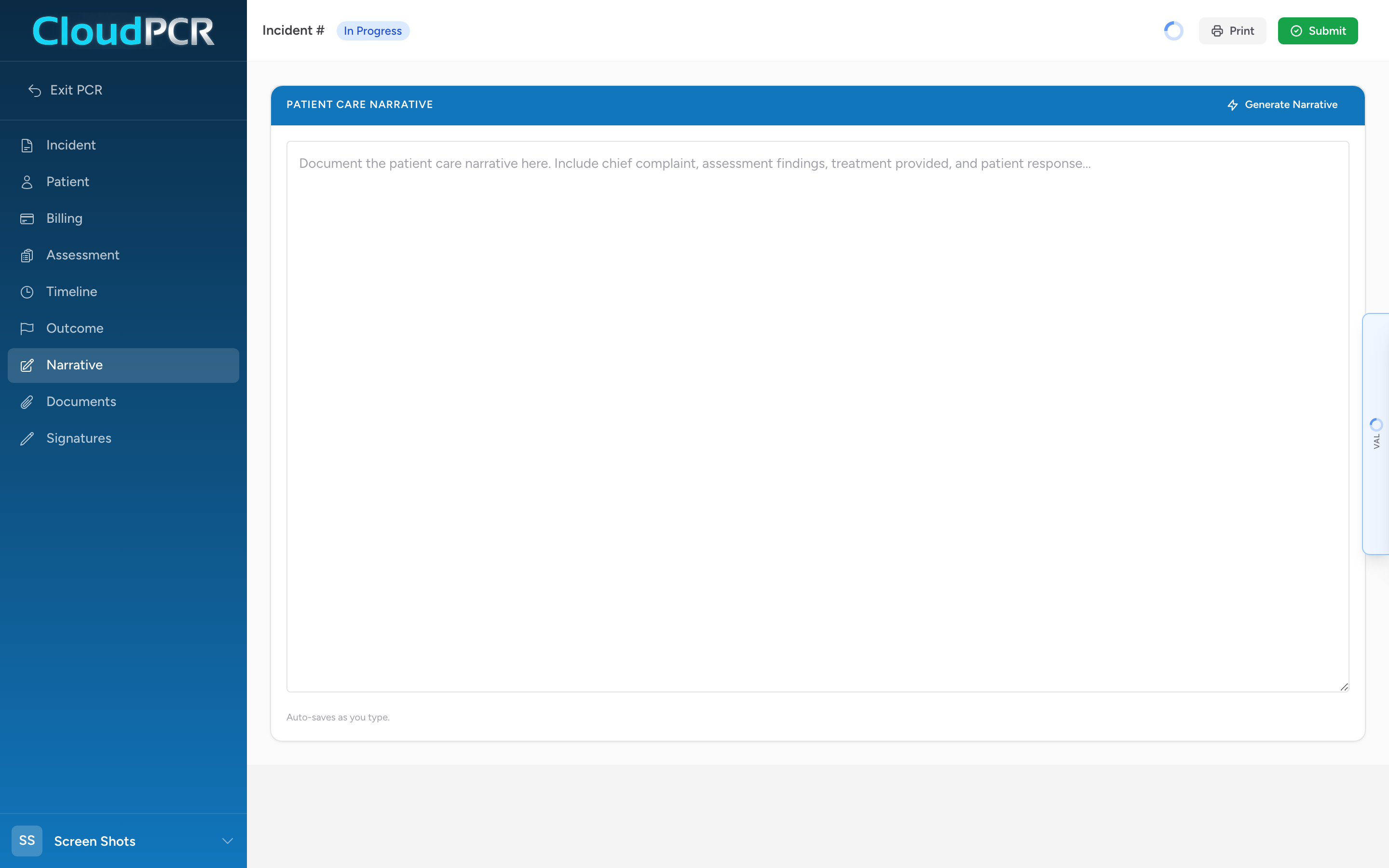
Where it lives
The narrative is its own tab — Narrative. It is a single large text area labeled Patient Care Narrative. What you type auto-saves as you type — there is no Save button to press.
A useful structure
CloudPCR does not enforce a structure. Most providers use one of two:
CHART
- Chief complaint — what the patient said is wrong.
- History of present illness — when it started, what they were doing, what they tried.
- Assessment — what you found.
- Rx / treatment — what you did.
- Transport — destination, mode, and condition on arrival.
SOAP
- Subjective — what the patient told you.
- Objective — what you measured and saw.
- Assessment — your impression.
- Plan — what you did and where you went.
What makes a good narrative
- Stick to what you saw and what the patient told you.
- Quote the patient when their words matter.
- Document the pertinent negatives — "no chest pain, no shortness of breath, no diaphoresis."
- Reference the treatments you gave and how the patient responded.
- Document the handoff — who took report and where.
An example
"66 y/o male with hx of HTN and CAD c/o substernal CP 8/10 that started 30 minutes prior to arrival while watching TV. Pain radiates to L arm, associated with diaphoresis and SOB. Patient denies recent surgery, anticoagulants, or sildenafil use. On exam: alert and oriented, skin pale and diaphoretic, breath sounds clear bilaterally, abdomen soft. 12-lead ECG: ST elevation in II, III, aVF — concerning for inferior STEMI. STEMI alert called to [receiving hospital] at 10:14. ASA 324 mg PO chewed at 10:08. NTG 0.4 mg SL at 10:10 with pain reduction from 8/10 to 5/10. IV established 18g L AC, NS at TKO. Transported emergent to [receiving hospital]. Pain 3/10 on arrival. Report given to RN [name]."
Important: Never copy and paste from another patient's PCR. Reviewers can tell, the audit log shows it, and on a bad day in court it can look like fraud.