
The Impression section on the Assessment tab is where you record what brought the patient to you, what you found, and what you think is going on.
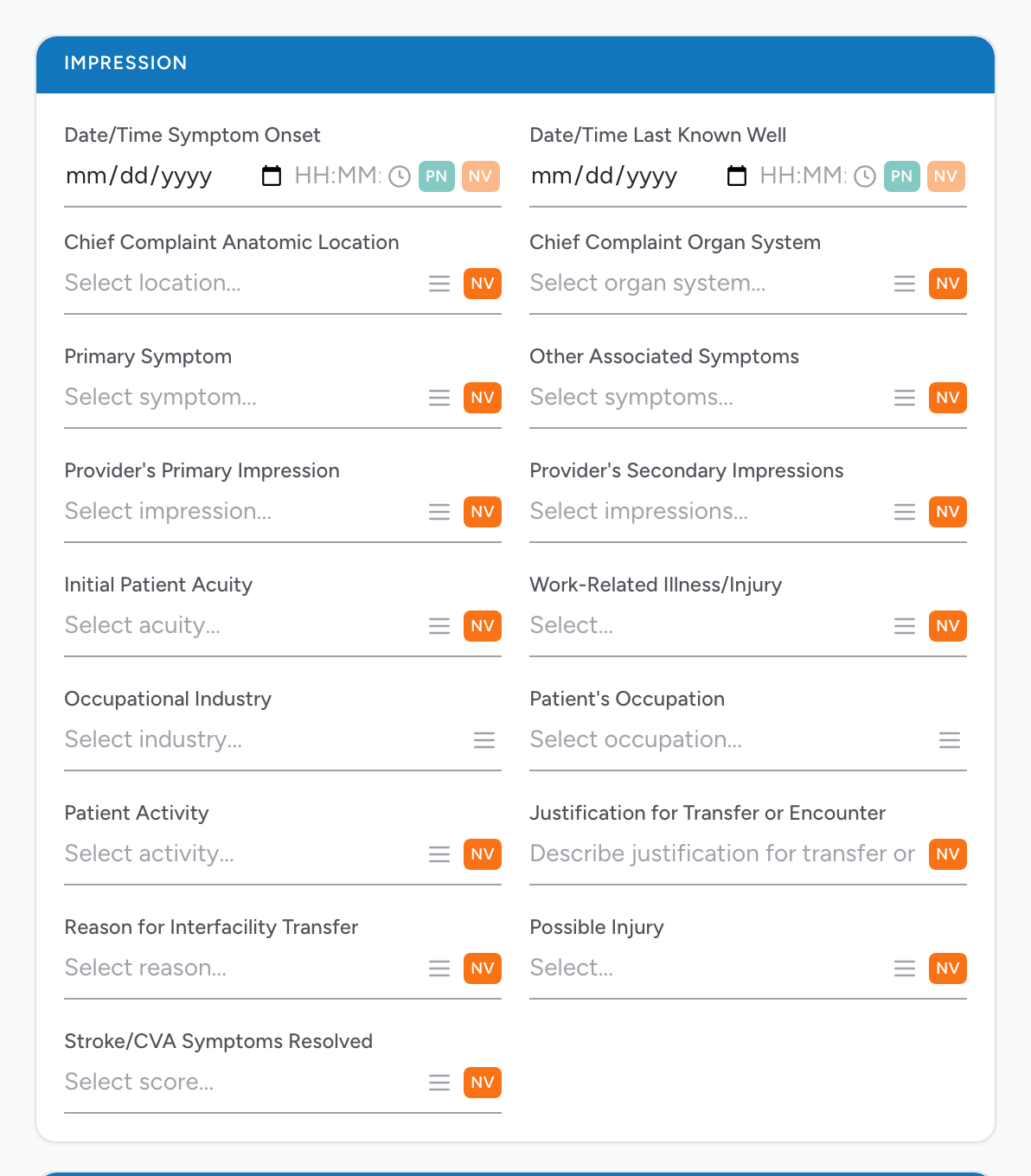
Timing
- Date/Time Symptom Onset — when the symptoms started. If you only know an approximate time, click the PN button and pick Approximate. If you do not know at all, pick Unable to Complete.
- Date/Time Last Known Well — the last time the patient was seen at their normal baseline. Critical for stroke calls.
Chief complaint
- Chief Complaint Anatomic Location — what part of the body.
- Chief Complaint Organ System — what system (cardiovascular, respiratory, neurological, etc.).
- Primary Symptom — the main thing the patient is feeling. Start from the standard symptom list, or search the ICD-10 diagnosis list if you cannot find the right one.
- Other Associated Symptoms — multi-select. Click a symptom in the list to mark it as present; click the ~NP button next to an option to mark it as not present (the patient denied it) instead.
Your impression
- Provider's Primary Impression — your best clinical assessment of the cause, from the standardized impression list.
- Provider's Secondary Impressions — multi-select. Anything else clinically relevant.
- Initial Patient Acuity — how sick the patient is. Pick from the list.
Work-related injury
- Work-Related Illness/Injury — whether the illness or injury is work-related. Pick from the list.
- Occupational Industry — industry the patient was working in.
- Patient's Occupation — their specific occupation.
- Patient Activity — multi-select. What they were doing when it happened.
Interfacility transfers
- Justification for Transfer or Encounter — free text.
- Reason for Interfacility Transfer — the standardized code list.
Injury and stroke flags
- Possible Injury — yes activates the Trauma section. Pick this for any call where trauma is part of the picture.
- Stroke/CVA Symptoms Resolved — whether stroke symptoms resolved before your arrival or during your care.
Primary symptom vs primary impression
The primary symptom is what the patient feels (chest pain). The primary impression is your assessment of the cause (STEMI). These are different fields because the same symptom can have many different causes, and your state cares about both.
An example
You respond to a 60-year-old male with chest pain that radiates to his left arm. His 12-lead shows ST elevation in leads II, III, and aVF. Primary Symptom Chest Pain; Other Associated Symptoms Diaphoresis +; Primary Impression STEMI — Inferior Wall; Initial Patient Acuity Critical; Work-Related Illness/Injury No.
Required fields: Which Impression fields are required depends on your state and your agency's form setup, and required fields are marked on screen. If a field is genuinely unknown, use the NV button rather than leaving it blank.