
The American Heart Association's Mission: Lifeline EMS program publishes a measurement set every agency providing 911 emergency medical services is expected to track. Mission: Lifeline Metrics computes all twenty-six measures from the 2027 specification against your agency's PCRs, grouped by category, with a per-measure drill-down to the underlying records.
How to use it
- Open Operations → AHA Mission: Lifeline.
- Pick a Range — 1m, 3m, 6m, or 12m. The default is 3m.
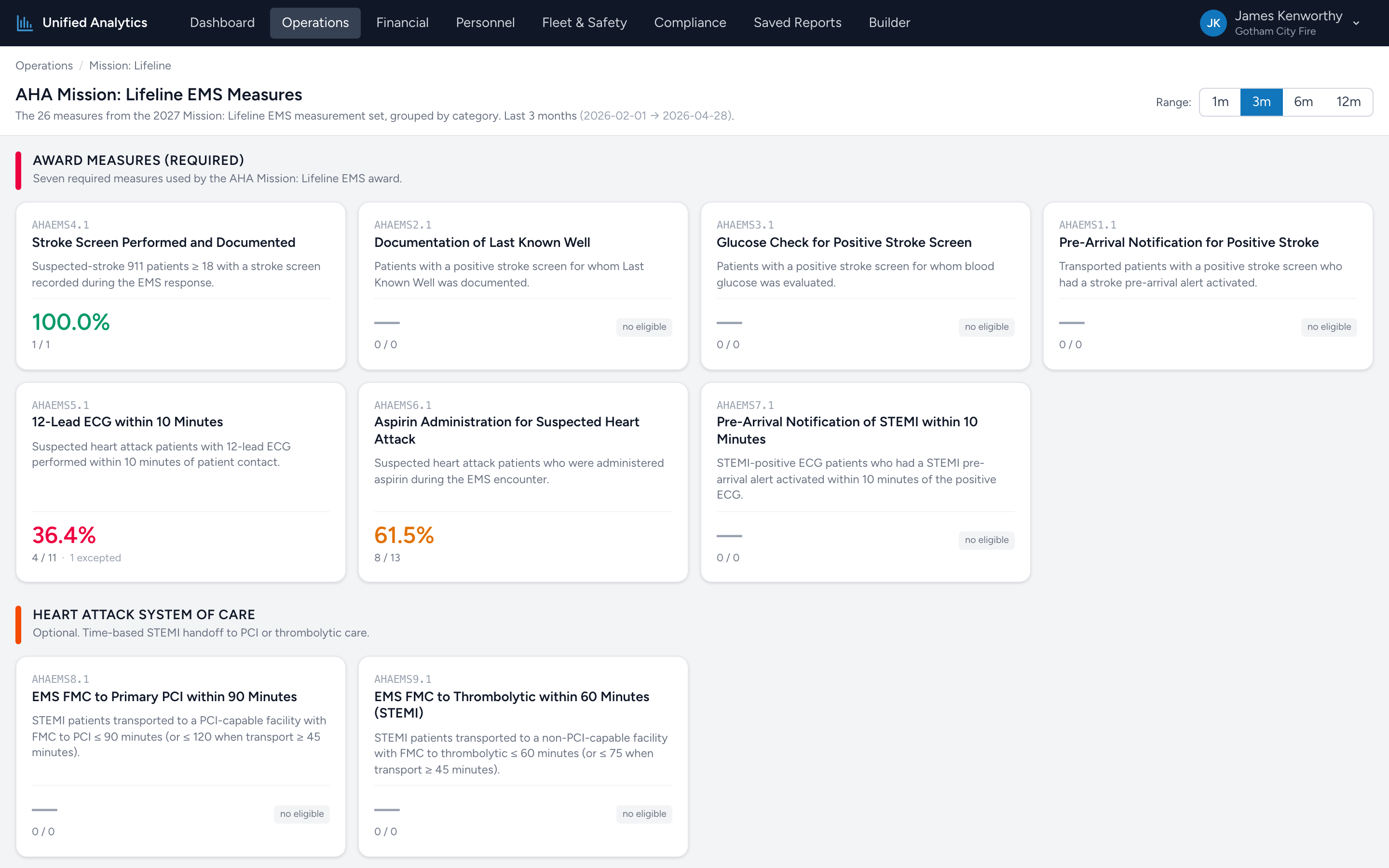
- The page renders five category sections, each with one card per measure. Cards populate as their data comes in.
- Click any measure card to drill into the per-PCR detail.
The five categories
- Award Measures (required) — the seven required measures used for the AHA Mission: Lifeline EMS award. These are the measures every agency in the program reports on.
- Heart Attack System of Care — optional. Time-based STEMI handoff to PCI or thrombolytic care.
- Stroke System of Care — optional. Time-based stroke handoff to thrombolytic, endovascular, or CT.
- Cardiac Arrest System of Care — optional. PSAP-to-compression and PSAP-to-defibrillation timing.
- Quality Measures — optional. Scene time, bystander interventions, post-arrest care, diagnostic accuracy, and outcomes.
How a card reads
Each card has the same shape:
- Measure key — a short identifier such as SYS.001, used for internal reference.
- Measure name and description — what the measure tracks, taken from the AHA specification.
- Percent — the headline number. Color-coded green when 75% or higher, amber from 50% to 74%, and rose below 50%.
- Numerator and effective denominator — how many records met the criteria, out of how many were eligible after exceptions.
- Pending badge — appears when the measure is in the spec but the calculation logic is still landing in a follow-up release. The card is shown in gray.
How the math works
The percent is calculated as numerator divided by (denominator minus exceptions). Exceptions are spec-defined scenarios that remove a record from the denominator only when the numerator condition is not met — for example, a patient who refused care will be excluded from a measure that requires a particular treatment, but only if that treatment was not given. The footer at the bottom of the page restates this so the math is never a mystery.
Tips
- Start with the Award Measures section. These are the seven the AHA actually scores you on. The other four sections are valuable but optional.
- Click the cards in the red and amber bands first. They are the measures most worth investigating, and the detail page shows you exactly which PCRs are dragging the percentage down.
- Run weekly or monthly. Measure trends move slowly. A six-month range gives a stable picture; a one-month range is for spotting recent regressions.
Where the data comes from
CloudPCR is the source. Mission: Lifeline asks CloudPCR's reporting service for the full measurement set against your agency's PCRs in the chosen window — there is no separate setup, no field mapping, and nothing to maintain on this side.
For the per-PCR drill-down on any single measure, see Inside a Mission: Lifeline measure.