
What service requests are for
A service request lets you report a vehicle problem that needs attention from your agency's maintenance team. This is for mechanical issues, electrical problems, broken equipment, or anything else on the vehicle that is not working the way it should.
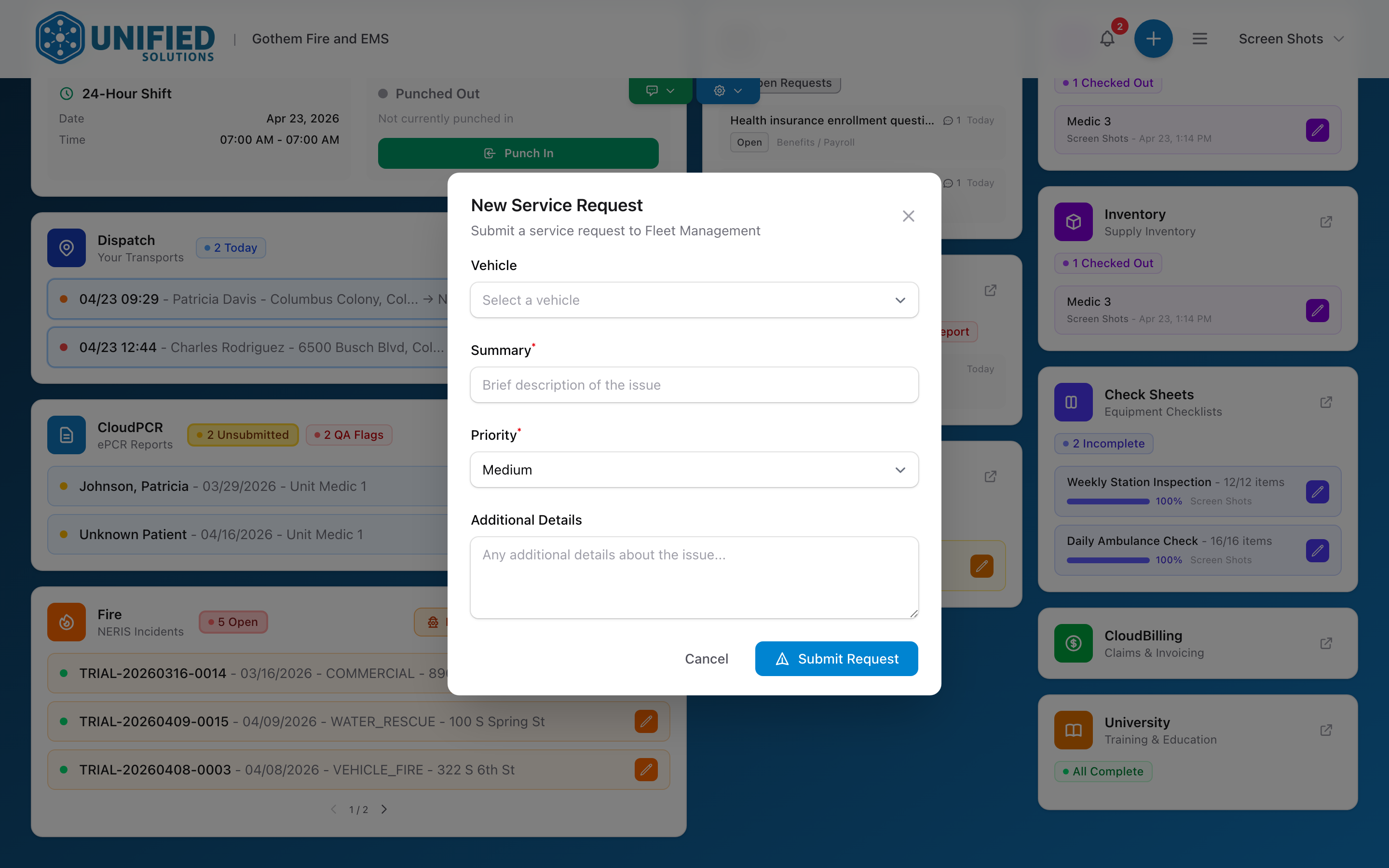
How to fill out the form
- On the dashboard, click the + button.
- Click New Service Request.
- A form opens on the dashboard with these fields:
- Vehicle — pick the vehicle with the issue.
- Summary — a short description of the problem. For example: "Driver side mirror loose" or "Check engine light on."
- Priority — how urgent the issue is. Pick from Low, Medium, High, or Critical.
- Additional Details — the full details. When did you first notice it? Does it happen all the time or only sometimes? Is the vehicle still safe to drive?
Click Submit Request when you are done.
Choosing the right priority
When in doubt, err on the side of a higher priority. A vehicle that might not be safe to drive is always urgent. A squeaky belt that has been squeaking for a week is less urgent. Here is a rough guide:
- Critical — the vehicle is out of service until this is fixed. Brake failure, a fluid leak on the ground, any warning that the vehicle is not safe to drive at all.
- High — the vehicle works but has a problem that needs same-day or next-day attention. A warning light that just came on, a noise that started today, a seatbelt that will not latch.
- Medium — the vehicle works but something is wrong and it needs attention soon. A broken dome light, a sticky door latch, a heater that only works on high.
- Low — cosmetic or minor issues that can wait for the next scheduled service. A torn seat cover, a faded decal, a cup holder that wobbles.
An example
During your morning truck check, you notice the suction unit is not generating adequate pressure. You click the + button, pick New Service Request, select the vehicle (Rescue 3), enter the summary "Suction unit not generating adequate pressure," set the priority to High (because you need working suction on every call), and in the description write "Tested suction unit during morning check. Gauge shows only 150 mmHg — should be at least 300. Tried replacing the canister and tubing, same result. Unit may need pump serviced or replaced." You submit it, and your fleet manager gets a notification.
Tip: The better your description, the faster your maintenance team can fix the problem. Include what you already tried, when the issue started, and whether the vehicle is still safe to use.