
The Trauma section only matters if the patient has an injury. For trauma calls, this section is where you record the mechanism, the injuries, and whether the patient meets your state's trauma triage criteria.
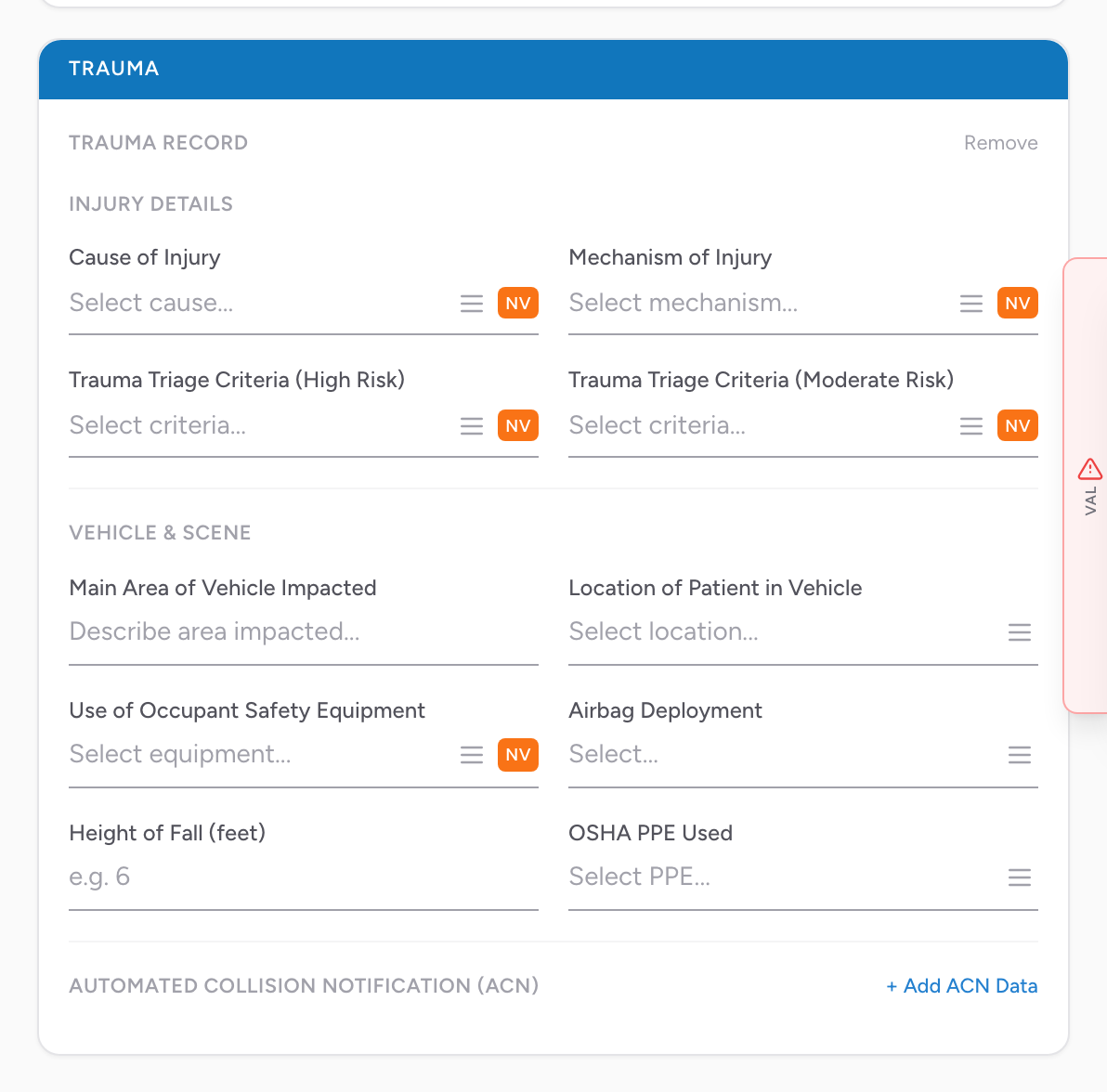
Opening the section
On the Assessment tab, the Trauma section starts collapsed with a single Add Trauma button. Click it to open the section. (If you set Possible Injury to Yes in the Impression section, this section opens for you automatically.)
If you open it by mistake, click Remove at the top to collapse it again.
Injury Details
- Cause of Injury — multi-select. Pick what caused the injury.
- Mechanism of Injury — multi-select. Pick from the list.
- Trauma Triage Criteria (High Risk) — multi-select. Check every high-risk criterion the patient meets.
- Trauma Triage Criteria (Moderate Risk) — multi-select. Check every moderate-risk criterion the patient meets.
Vehicle & Scene
- Main Area of Vehicle Impacted — free text (e.g. driver front, passenger side).
- Location of Patient in Vehicle — where the patient was sitting. Pick from the list.
- Use of Occupant Safety Equipment — multi-select. Pick every safety device that was used.
- Airbag Deployment — multi-select.
- Height of Fall (feet) — number.
- OSHA PPE Used — multi-select.
Automated Collision Notification (ACN)
For crashes where the vehicle sent telematics data (OnStar, etc.), click + Add ACN Data to reveal the ACN fields: ACN System/Company, ACN Incident ID, callback phone, date/time, location, vehicle body type, manufacturer, make, model, model year, multiple impacts, delta velocity, high probability of injury, PDOF, rollover, plus per-seat details.
Trauma triage
The two Trauma Triage Criteria fields map to the NEMSIS triage checklist. They are multi-select dropdowns — pick every criterion that applies. The form does not tell you which hospital to go to; that decision is on you and your protocols.
An example
You respond to a single-car rollover. The driver was ejected from the vehicle. He has obvious deformity to his right femur and is complaining of abdominal pain. In the Trauma section you pick the cause of injury that matches a motor vehicle crash and set the mechanism to blunt. Under Trauma Triage Criteria (High Risk) you pick the ejection and long-bone fracture criteria. Under Vehicle & Scene you set Location of Patient in Vehicle to Driver. You contact medical control and divert to the regional Level 1 instead of the closest community hospital.